

I want to tell you something I know to be true.
Not a framework. Not a theory I read in a book. Not advice borrowed from someone who heard it from someone else.
Something I lived, from the first scribble to the main stage, over nine years.
You can build something from nothing.
I mean that literally. An idea that does not exist in the world, that no one has built, that you have no money to fund, no connections to push forward, no roadmap to follow — you can take that idea and make it real. You can put it in front of millions of people. You can watch it change how people work.
I know because I did it.
The idea came before everything. Before the money, before the team, before the product. Just a belief that something needed to exist.
“When you grow up, you tend to get told that the world is the way it is and your life is just to live your life inside the world. Try not to bash into the walls too much, have a nice family life, have fun, save a little money. But that’s a very limited life. Life can be much broader once you discover one simple fact. And that is, everything around you that you call life was made up by people that were no smarter than you.” - Steve Jobs
It Starts With Belief
I was 21 years old, managing social media for ODEON Cinemas. My job was to write copy in a spreadsheet.
A spreadsheet.
Even then, before I knew what a product roadmap was or had ever thought about building a company, something nagged at me. This is the wrong tool for this job. There has to be a better way to manage this.
That feeling got louder when I moved to NOW TV at Sky. The team was bigger. The stakeholder groups were more complex - design, copy, agency partners, internal approvals, legal sign-off. NOW TV was part of a publicly traded business, which meant social media posts required formal approval at a significant level at that time. The workflow was chaotic. The tools were worse. And nobody seemed to find that strange.
It compounded again when I started my own marketing agency, helping brands manage their social presence. Every client, every team, every project, the same problem. Talented people spending enormous amounts of time and energy wrestling with processes that should have been invisible, leaving less of both for the actual creative work.
And then a thought stopped me completely.
It was 2010, 2011. I was working inside large marketing teams where the calendar - what are we publishing, on which channel, on which date, to which audience - was the central artefact of everything we did. It was how strategy became execution. It was how teams stayed aligned. It was the backbone of the entire operation.
And yet there was no marketing calendar software. Not one. Hootsuite existed and had built a serious social media management business, but it was not calendar-based. The most important workflow in marketing had no dedicated product built around it.
I could not believe it.
How on earth had nobody built this?
The Size of the Gap
The more I sat with it, the clearer two things became.
First: this was a massive problem for companies across the world. Not a niche frustration. Not a minor inconvenience. Every business trying to manage social media, which by 2011 was becoming non-negotiable, was dealing with this. The market was enormous and the gap was real.
Second: if I could build a product that solved it properly, I could build a serious company. A product used by tens of millions of businesses. Something that could, one day, change my life and the lives of everyone who worked on it.
That realisation changed everything.
This wasn’t just an idea. It was a vehicle. A vehicle for building something that mattered, for learning everything I didn’t yet know, for creating a business that could be genuinely valuable.
So I started.
I was 23 years old. I scribbled the product down on paper.
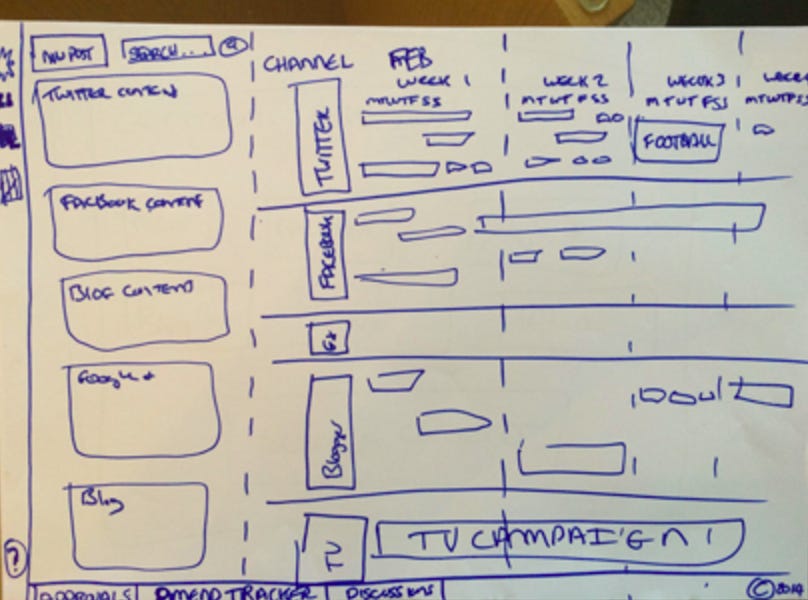
A content calendar as the core experience. Collaboration built in, multiple team members working together in one place. Approvals, analytics, publishing, all under one roof. The power of an enterprise marketing operation, available to any business, anywhere.
ContentCal.
There was no product. No team. No funding. No network. No roadmap. Just a belief so strong it felt less like an idea and more like something I had already decided would happen.
That distinction matters more than anything else I will tell you.
Conviction Is Not Passive
When I say I believed in it, I don’t mean I hoped it would work out. I don’t mean I was quietly optimistic. I mean I had removed the possibility of it not happening from my thinking entirely.
That kind of conviction changes how you move. It changes what you’re willing to do. It changes how you react to obstacles.
When belief is that total, obstacles stop being reasons to stop. They become problems to solve.
I scribbled out the product ideas myself. I found a designer. That designer wasn’t right. I found another. Then another (Who became my kindred spirt in product design). I spent months iterating on the product, rebuilding decisions that nobody else was watching or judging. I used my own money to get the first version built and a small amount of seed capital, around £5,000, that came from family who believed in me before anyone else had reason to.
Then I needed more. I didn’t have a network of investors. I wasn’t from a wealthy background. I had no warm introductions.
So I started where I actually was: my personal network. Face-to-face. Conversation by conversation. The kind of slow, unglamorous relationship-building that doesn’t make for a clean fundraising story but is how most early rounds actually get done.
That’s how I met a man called Derek.
Derek was the first person outside of my family and my managers who did three things I had never experienced together before: he believed in me, he coached me, and he parted with his own hard-earned money to invest in my business.
I want to pause on that for a moment. Because at the time, it meant everything.
A person who barely knew me looked at what I was building, looked at who I was, and decided it was worth betting on. That act of faith, from someone who had no obligation to give it, did something to my belief in myself that I had never felt at that level before. It validated not just the idea, but me.
That changed things. Not just practically, in terms of capital. Psychologically, in terms of what I now believed was possible.
I eventually joined an accelerator called the Accelerator Academy, and that’s where the business really began to take shape. The right environment, the right pressure, the right people asking the right questions at the right time.
The Hours Nobody Sees
I want to be honest about this part, because the story of building something from nothing sounds clean in retrospect. It wasn’t.
I worked 12, 14, 16-hour days. For years. If you look hard enough, somewhere on the internet it says I worked every day for a year straight. I actually did. Not always at full intensity. But every single day, for over a year, I was working. I gave the business every day I had.
I wouldn’t recommend that to everyone. The cost of it is real, and I understand now what I was trading. But in that season, with that goal, it was what the mission required. And I gave it willingly.
I was obsessed with learning.
I wanted to meet everyone who had built something before me. Every founder, every mentor, every investor who would give me an hour. I wanted the keys to the mental kingdom, the accumulated experience that takes other people decades. I read, listened, absorbed, asked questions constantly, and took every useful insight and put it straight to work.
That obsession with learning compounded as fast as anything else I did. Every mistake I made, I only made once. Every insight I earned, I built on immediately.
On Obsession
There is a version of this story that makes it sound like persistence and patience. That is not quite right.
The honest word is obsession.
To build something from nothing, you have to be obsessed. Obsessed with the product, every interaction, every friction point, every moment where the user experience could be sharper. Obsessed with forward motion, every week, is this better than last week? Every month, are we closer? Obsessed with becoming the best product in the market, not eventually, not one day, but as an active, daily pursuit.
You have to care about winning. Not in an ego-driven way. In the way that someone cares about a thing they have given their life to. You have to want it to succeed with everything you have, because there will be moments, and there will be many, where only that level of wanting keeps you in the room.
No one tells you this clearly enough: there is no greater demand in a professional context than building something from scratch.
Not running a large organisation. Not managing complexity at scale. Building something from nothing asks more of you than any of it, because nothing exists yet to carry any of the weight. You are the weight-bearer. Entirely. For longer than you expect.
To build something from nothing, you have to be obsessed. Not eventually, not one day — as an active, daily pursuit.
That is not a warning. It is a description of the terrain.
If you know what you are walking into, you can prepare for it. And if the idea is right, if the belief is real, you will find that the obsession doesn’t feel like a burden.
It feels like the most alive you have ever been.
Creating Something That Did Not Exist
Here is the part I find most extraordinary about all of this, even now.
ContentCal did not exist before I decided it would. The calendar-based interface didn’t exist. The collaboration layer didn’t exist. The combination of planning, approval workflows, analytics, and simplicity in one product, none of it existed in the market the way I had envisioned it.
I created something from nothing.
I mean that precisely. There was a gap in the world. A real problem that millions of people had, every day, at work. And because I believed in it hard enough, worked relentlessly enough, refused to stop long enough, build the incredible team that was the ContentCal team, that gap got filled.
A thing that did not exist now existed.
There was a gap in the world. Because I believed hard enough, worked relentlessly enough, refused to stop long enough, that gap got filled.
We scaled to 5,000 customers globally. We nearly ran out of cash twice, down to 30 days of runway on two separate occasions. Both times we survived. Both times, the belief that we would find a way was what kept the team moving while I went out and found a way.
In December 2021, we sold ContentCal to Adobe.
The Day on the Stage
When Adobe acquired us, they gave us a challenge: integrate ContentCal into the Adobe Express ecosystem in six months.
We did it in four.
And then, at Adobe Max, the biggest creative and marketing conference in the world, streamed online to millions of people, ContentCal was presented as a hero feature for Adobe Express. On the main stage. In front of an audience of millions of creatives around the world.
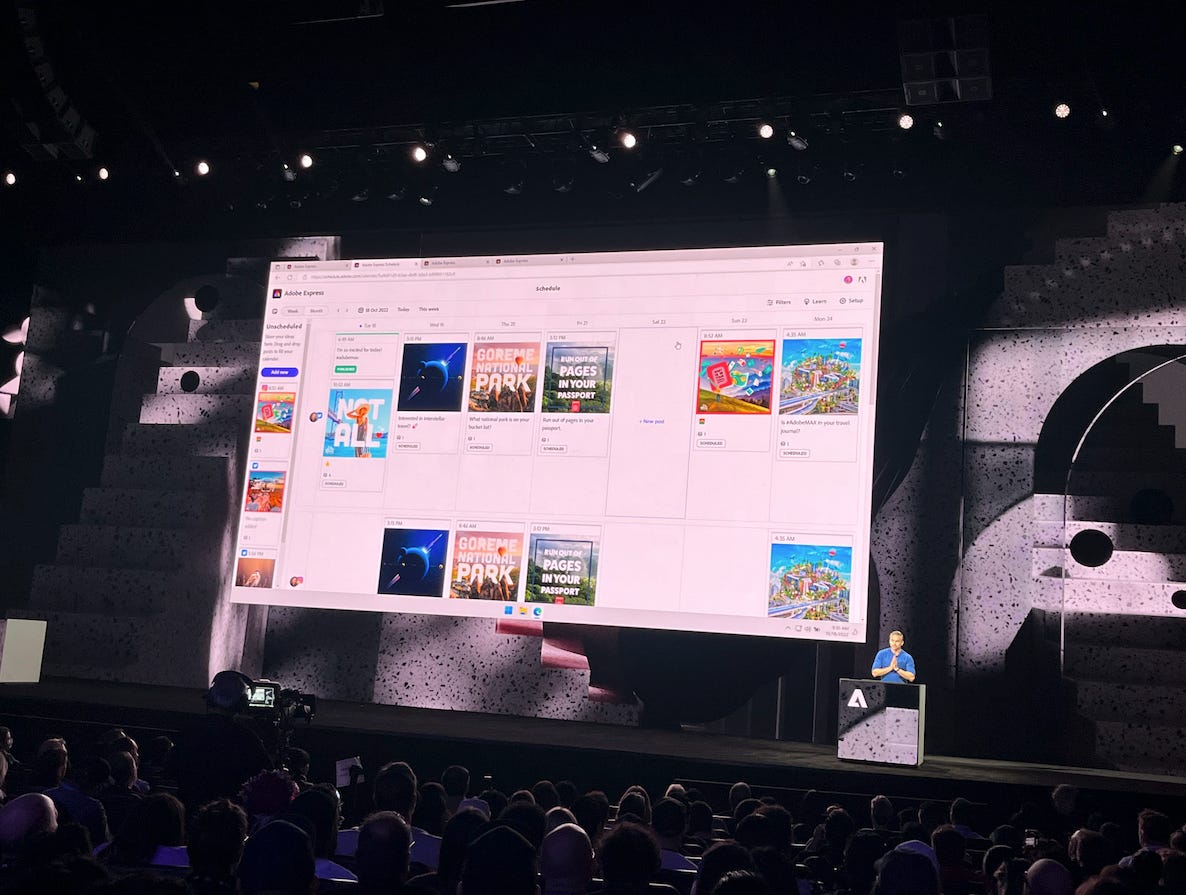
I will never forget that moment.
Not because of what it meant commercially. Because of what it represented.
Nine years earlier, I was a 21-year-old writing copy into a spreadsheet, thinking: there has to be a better way. A 23-year-old scribbling a product on paper with £5,000 and no network and no proof it was possible.
And there it was. On the main stage. In front of the world.
That is what building something from nothing looks like when it runs all the way to the end.
What I Want You to Know
I’m telling you this because I think the story of real creation, from nothing to something, gets lost in the noise of startup mythology.
People talk about growth hacks and fundraising strategy and product-market fit. All of that matters. But the thing that comes before all of it is simpler and harder than any framework.
You have to believe in something so completely that the gap between the idea and the reality stops feeling like a question. It becomes a direction.
You have to be willing to do whatever it takes, for as long as it takes, without the certainty of knowing it will work.
You have to be obsessed with learning, because the only way to close the gap faster is to get smarter faster.
And you have to be willing to create. To bring something into the world that did not exist before you decided it would. That is not a small thing. It is one of the most extraordinary things a person can do.
It is possible. I know it is.
I did it. And so can you.
One More Thing
Looking back now, I can see something I couldn’t see at the time.
All those acts of will; the relentless finding, building, raising, learning, iterating, I was creating leverage without knowing the word for it.
The product was leverage. The team I built was leverage. The investors I brought in were leverage. The brand we earned with 5,000 customers was leverage.
The obsession was the fuel. But the systems I was building, often without realising it, were what made the obsession compound instead of just burn.
If I were doing it again from the start, I would be just as obsessed. Just as willing to work the long hours in the early years. Just as relentless in the belief.
But I would be more deliberate about the leverage, earlier.
Because conviction builds the foundation. Systems build the rest.