

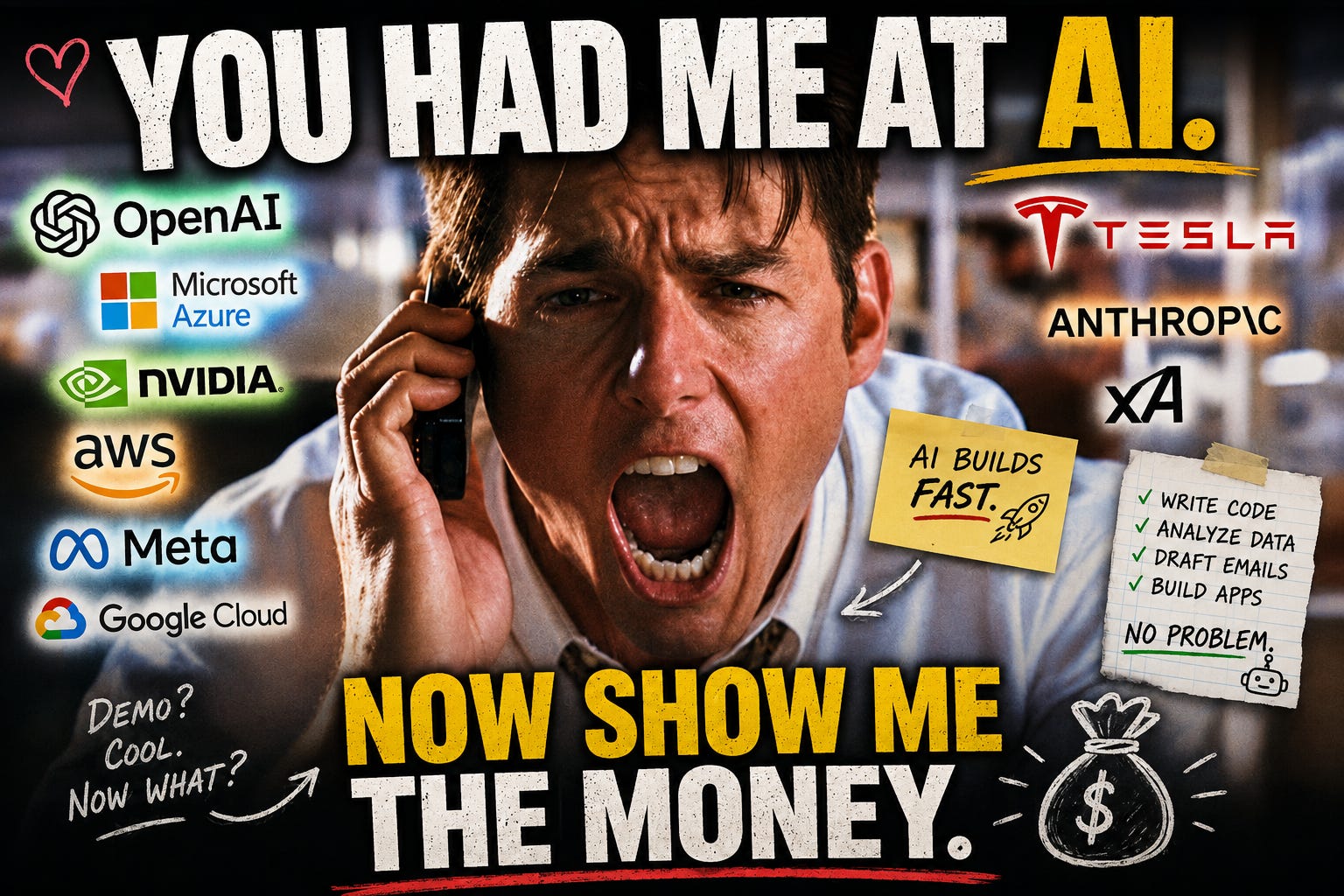
If you love business, sport and movies, you’ll love this.
There were two lines that made Jerry Maguire famous.
The one everyone quotes: “show me the money.”
The other one is: “help me help you.”
Both are being said to you right now, at once, by the same voice.
AI is sitting in every workflow you’ve got, quietly saying the same thing: Help me help you.
And it means it. It’ll do more than you can imagine. It’ll write the code, draft the deck, run the analysis, build the thing. But it can’t decide what’s worth building, or why, or for whom. It needs you to point it.
Bring the judgment, and it’ll take you to the money faster than anything in history has carried anyone.
Withhold it, and you’ll generate noise at superhuman speed.
Meanwhile, the market is screaming the other line straight back at you.
Show me the money.
Louder than any investor ever did. Not the valuation. Not the raise.
The revenue.
The proof that someone actually wanted what you made. Because in a world where anyone can build anything, that’s the only thing left that counts.
Two lines.
One demand each.
Help AI help you, so you can show the market the money.
So let me show you where the money actually is now, and what it’s actually for.
In business, money used to pay for the ‘build’.
The build is nearly free now.
So the question is, what are you paying for instead?
The headline numbers are a trap
Yesterday, SpaceX went public.
$135 a share. $1.75 trillion. Around $75 billion raised in a single morning. The largest IPO in the history of capitalism.
And it isn’t alone. OpenAI has filed to go public. So has Anthropic. Put those few names together and they could ask the public markets for something close to $3 trillion of fresh equity inside 18 months.
I’ve spent a lot of time in New York these last few years. When I travel somewhere, I have to understand why the place is the way it is to immerse myself in it. Lately, that’s meant trying to get my head better around how American capital markets work.
I was there last week and SpaceX was all anyone could talk about. So I did what I always do. I went and found the real numbers, the helicopter view, to see how much money was actually flowing into these companies once you strip away the noise.
Turns out, not much in the grand scheme of things.
Here’s the thing nobody says out loud:
Stack the whole record-breaking wave together, SpaceX, OpenAI, Anthropic, all of it, and as a share of the money actually available, it’s a rounding error.
US stocks are worth north of $60 trillion. Even a few hundred billion in IPO proceeds, the biggest year in history by a distance, lands at under 0.5% of that. The drag on a broad index fund from swallowing it is about what the market moves in 30 minutes on an ordinary day.
The largest listings ever priced, the numbers screaming across every headline, barely register against the capital that’s just sitting there.
The headlines are built to look enormous. In proportion, they’re tiny.
Capital is not scarce
Anyone telling you otherwise isn’t looking. There’s more money in the system than at any point in my lifetime. It’s just more fussy than ever about where it lands.
So watch where it’s going.
Right now, it’s going into the infrastructure layer of AI. The picks and shovels.
The market is voting with its feet.
The stock gains have concentrated in exactly the same place. The chipmakers. The hyperscalers. The data centre operators. The power companies.
That’s where the money is. It’s real, and it’s vast.
And almost none of it is for you (yet)
If you’re building on top of the rails, you’re in a different layer, playing for different money, under different rules.
And here’s what most founders miss while they’re either drooling or panicking over the trillions.
The infrastructure boom is real and it’s early. At the very same time, the application layer, the one the rest of us actually build in, has barely started. The next phases of this are the platforms and the productivity, the companies built on top of the compute.
We are nowhere near peak application.
The rails are being laid at trillion-dollar scale. The cities that sit on those rails don’t really exist yet.
Right now, I build in the cities. So do you.
And here, the rules have changed dramatically.
The old deal: the money paid for the build
The old deal was simple.
The money paid for the build.
I started my first software company in a world where getting from idea to product meant engineers on payroll, plural. It meant years. It meant raising capital to pay those engineers through the years it took before a single customer could touch the thing.
The build was the mountain.
Everything else came after, if you survived the climb.
A board meeting about runway was, underneath, always a meeting about the build. How many engineers, for how many months to ship the thing that might move the numbers. We rebuilt core parts of the product more than once, and every rebuild was a draw on the same well. Time and money, spent before we could know if it would work.
You spent first. You learned later. The gap was years wide.
The build is becoming ‘free’
I’m co-founding an AI-native company for the first time. AcademyAI.
We built a fully functional, enterprise secure product in a month. A month.
And at the company I am CEO of, JAAQ, we re-platformed from V1 to V2, an infinitely more powerful product, clinical guardrails built in, a highly complex deployment model into healthcare, designed to serve over 2 million users from day one. That would have taken two years. We’ll do it in six months.
Sit with that. A product, in the world I came from, would have taken a year or two and well over a £1m+ before a customer ever saw it. Now takes a few months. At a fraction of the cost. A two pizza team max.
Now, I’ll be careful with the word free, because building is never really free. There’s always taste and judgment behind anything good. But the acceleration is so violent it changes the category of the problem. A genuinely AI-augmented operator isn’t 20% better than they used to be. They’re 5x to 10x.
One person can do what a team did in days instead of quarters.
And this isn’t just at my companies.
Build costs are down by as much as 80%. Teams on $50,000 budgets now ship what recently cost $250,000.
Solo founders, one person, no team, have gone from under a quarter of new US startups to more than a third.
This isn’t a forecast. It’s the new floor.
The thing we used to raise millions to do, a small AI-native team now does in weeks.
So if the build is nearly free, here’s the only question that matters.
What is the money for now?
The new deal: the money is for the money
Simple. The money is now for whatever is still hard.
Sales. Revenue. Distribution. Brand. Trust. Implementation.
None of it got cheaper. If anything it got harder, because when everyone can build, the noise gets louder, and cutting through it costs more.
AI will write your code. It won’t earn a sceptical buyer’s trust.
It will draft your launch copy. It won’t build a brand people reach for by reflex.
It will spin up a slick demo overnight. It won’t survive the messy, political reality of being implemented inside a real organisation.
It will generate a thousand outbound emails. It won’t do the slow, patient work of distribution that compounds over years.
That’s where the money goes today. Not into making the thing. Into making the thing matter.
Revenue: easy to start, brutal to scale
Two numbers proves any of this is real for startups and scale-ups. Revenue and revenue growth rate.
And revenue has split in two.
For a startup, getting to revenue has never been easier. Cheap to build, cheap to test, fast to put a real product in front of a real buyer and find out if they’ll pay. A founder with taste and $50k now learns in three months what used to cost three years and $3 million.
For a scaleup, it has never been harder.
The same cheap building that let you in lets everyone else in too.
Your buyer is drowning in credible-looking products that all demo beautifully, and they’ve learned, expensively, that the demo means nothing.
The enterprise data is brutal. MIT says that around 95% of enterprise AI deployments delivered zero measurable return. Not low. Zero. For every 33 proofs of concept a large enterprise starts, 4 reach production. The share of companies abandoning most of their AI efforts jumped past 40% last year, from 17% the year before.
Easy to get the pilot. Brutal to get the contract.
So the path now has a shape. A gentle on-ramp, then a cliff.
Most people read that as bad news.
I read it as the best news a serious operator has had in years.
Most founders quit long before they reach the ‘its getting serious’ stage.
They get the cheap, intoxicating early proof, mistake it for the finish line, and wash out the moment the real work starts.
The graveyard of ideas is about to become enormous. And for the first time, it’ll be full of genuinely good ideas, properly built, that simply couldn’t get past the easy part.
In the old world they’d have died in construction and we’d never have known.
That graveyard becomes the moat for serious people.
When the barrier to entry collapses, the barrier to scale becomes everything.
And the barrier to scale is grit, quality, and a willingness to do the unglamorous work while everyone else is celebrating the on-ramp and then quitting.
There has rarely been a better time to be a patient, quality-obsessed operator surrounded by people who give up.
The quality bar is judge and jury
So what gets you over the hump?
Quality.
And the quality bar has become the judge and jury of this entire era.
It shows up in three places, and you have to clear all three.
Product quality, beyond vibe coding. Anyone can vibe-code something that works in a demo now. The first 80% appears like magic. But the gap between a thing that demos and a thing people pay for and live in is enormous, and AI hasn’t closed it. The hard 10%, the thousand small decisions about humans rather than code, is the part no model hands you. That’s where the 95% of pilots died. The demo was never the point. The hard 10% was always the point.
Process, beyond AI slop. It’s trivial now to use AI to produce more. More copy, more code, more noise. Most of it is slop, and slop is worse than nothing, because it costs real work to clean up. The prize was never more output. It is genuinely better process. Using AI to raise the quality and speed of real work, not to flood the world with mediocre volume.
Real outcomes, measured, by industry. The bar isn’t whether your AI is impressive. It’s whether it changed something you can count, in the place it was deployed. Did the patient get better. Did the business save or make real money. Did the factory work more efficiently. Health, finance, transport, heavy industry, each has its own unforgiving definition of a real outcome.
The quality bar isn’t a feeling. It’s a measured result in someone’s actual operation.
That’s the only thing that turns a pilot into a contract, and a contract into a company.
What this looks like from my own desk
I’m living all of this across three very different seats, and they sharpen each other.
At JAAQ, the question is how to get the quality bar so high as we scale that it becomes the moat. Healthcare is the most unforgiving place imaginable to be ‘sloppy’, which is exactly why it’s the right place to be demanding. So the focus is deep product quality, safe AI in a clinical context, clinical governance at every single layer, and working hand in hand with the health system to prove outcomes rather than assert them. Not breadth. Depth. Scaling deep inside the partners we already have until we’re indispensable, not just present. And turning a small, growing business into a genuinely AI-native one as it grows, so leverage compounds instead of headcount.
At AcademyAI, the question is speed of quality. Make the product so good, so fast, that we’re past the demo and into something real before the field catches up. Show customers early, co-create with them, so the product is shaped by the people who’ll pay for it instead of guessed at in a room. Design the go-to-market early and deliberately, built to win, instead of bolting it on in a panic at the cliff. And build a small AI-native team of real power, where every person runs at that 5x multiple, rather than a big team that mistakes its own size for progress.
And in my advisory work, I sit with pre-AI companies trying to figure out how to get the most out of all this. Honestly, it’s the most interesting seat of the three. Because the gap between opinion and reality is enormous, and most of the loud opinions are uninformed, held by people who’ve never actually built with this or measured anything. The truth, from where I sit, is less dramatic than the cheerleaders and far more profound than the sceptics.
AI isn’t magic. It’s operating leverage. And leverage in the right hands is enough to remake an industry.
Three seats, one lesson.
The build is no longer the contest.
The contest is quality, proof, and the human work around the product. And that contest is won by the operators willing to climb the cliff after everyone else has stopped to take a breather.
I won’t pretend I know where all of this lands. I’m suspicious of anyone who claims they do.
But there’s one thing I’ll say with no hedge.
This is the biggest creator of productivity, output, and wealth of our time. The largest since the internet. Larger IMO.
The trillions going into the ground aren’t a bubble of nothing.
They’re foundations.
And the layer being built on top of them has barely begun. The opportunity is real, it’s early, and it’s bigger than almost anyone is willing to say out loud.
But none of that changes the question. It sharpens it.
The money’s in the system. The opportunity is the biggest of our lifetimes. The build is nearly free.
None of that is the test.
The test is the oldest one there is.
Did someone want it.
Did they pay.
Did they stay.
Now show me the money.